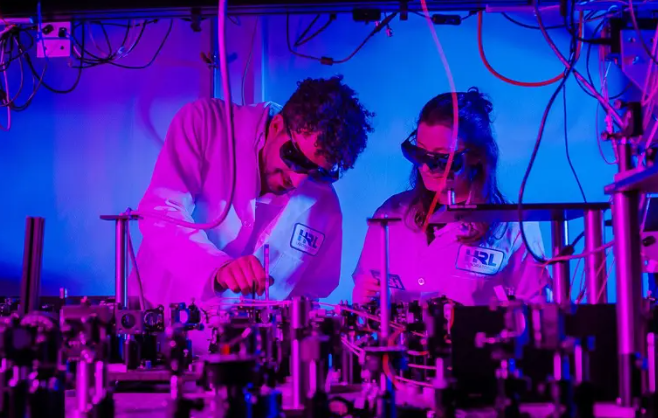
IBM hinted in recent months that it was planning some quantum-related M&A activity, and now it’s making a move with an agreement to acquire HRL Laboratories, a company that has deep expertise in silicon-spin qubit and quantum dot technology, among other areas, from current majority joint owners GM and Boeing.
The deal comes just two months after IBM said it planned to invest $10 billion in quantum in the coming years in R&D, M&A, and other endeavors. I wondered at that time if a different qubit modality could be central to M&A consideration. Notably, while silicon-spin qubit technology is distinct from superconducting qubit technology–the approach IBM has been heavily focused on for many years–many sources have noted that the two technologies share some common traits, like leveraging silicon-based manufacturing techniques, and could be on a path to further converge. Some news stories are suggesting IBM is hedging its bets on superconducting by investing in another modality, but it is not that cut and dried.
For IBM’s part, the company said in its announcement about the HRL acquisition that HRL’s silicon-spin qubit engineering “will complement and extend IBM’s long-term mission to scale increasingly powerful quantum computers and accelerate its quantum vision.”
It did not announce a price tag for the acquisition, but said the deal should close by the end of the current quarter. For you old-heads (me included), HRL was once Hughes Research Labs, operated by Howard Hughes along with Hughes Aircraft. GM bought the company in the 1990s and spun it off, after which Boeing bought a major stake in it. It continued under joint ownership for more than 25 years until now; IBM said both GM and Boeing will continue to partner with IBM on HRL activities post-acquisition.
(I have to admit right now it is bothering me that calling HRL Laboratories by its full name seems redundant (Hughes Research Labs Laboratories, right?) Whatever, it’s all going to be IBM soon…)
“The HRL team will help IBM push even farther forward toward the frontiers of quantum innovation,” said Jay Gambetta, IBM’s Director of Research and IBM Fellow. “This talented group of researchers brings a broad portfolio of technologies that will strengthen IBM’s long-term plans to deliver useful quantum computing to the world, bringing together advances across quantum computing, quantum sensing, and quantum networking to enable the applications of the future.”
“Joining IBM is the natural next chapter for what we have built at HRL, where our team has dedicated years to exploring paths to how future quantum computers could be built at scales that today seem impossible,” said Rob Vasquez, President and Chief Executive Officer at HRL “We now look forward to leveraging IBM’s industry leadership and working alongside their world-class talent on fundamental infrastructure to take this vision forward. Additionally, our cutting-edge physical and information science innovations will combine with their advanced research capabilities to deliver an unmatched suite of technology solutions for our commercial and government customers.”
As noted above, quantum sensing and quantum materials research could be worth watching as much as quantum computing as HRL gets absorbed into IBM. I have been thinking that quantum sensing could be another area in which IBM flexes its M&A muscles, but we’ll see.
Image: Two HRL employees who likely will soon change into lab coats with the IBM logo on them (Source: IBM)
Quantum News Nexus is a site from freelance writer and editor Dan O’Shea that covers quantum computing, quantum sensing, quantum networking, quantum-safe security, and more. You can find him on X @QuantumNewsGuy and doshea14@gmail.com.




Leave a Reply