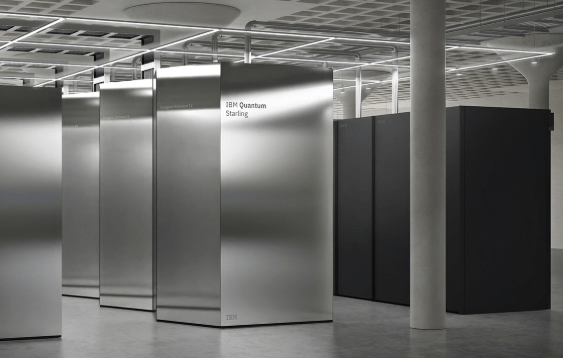
IBM is planning to invest more than $10 billion over the next five years in quantum-related activities, “including in R&D, capex, ecosystem partnerships, manufacturing scaling, and M&A,” according to an SEC filing.
Despite its status as a quantum computing pioneer, IBM has not always been very vocal about how much money it is spending on quantum and where–or how much money it is making (There was not much follow-up to an early 2025 claim that it had made $1 billion in revenue, cumulatively, between 2017 and 2024). But, it should come as no surprise that IBM is feeling a bit more bullish than usual after being tapped to receive $1 billion in funds from the federal government last week.
Some of the $10 billion likely will be allocated toward the Anderon quantum chip foundry IBM pledged to build in connection with the government funding, but the other thing to take note of here is the mention of M&A. Though it has invested in other quantum firms, IBM has never outright acquired another quantum company. It has been largely focused on organic developments and its own roadmap to deliver a fault-tolerant quantum computer by 2029. Still, it could be starting to feel some competitive heat and/or seeing some opportunities to strengthen and boost its quantum fortunes through M&A.
That makes me wonder who could be an acquisition target–maybe a firm working with a different quantum computing modality, maybe one or more specializing in segments like sensing, software, or security? Maybe one that already has a superconducting foundry operation?
Not that IBM needs help expanding, or is lacking for real-world progress from its organic efforts. As the SEC filing noted, “To date, IBM has deployed over 90 quantum systems, including more quantum computers than reported by all other industry players combined. The company has also built a global client and partner ecosystem spanning more than 325 Fortune 500 companies, startups, universities, and government agencies already using IBM’s global fleet of quantum computers to tackle scientific challenges across chemistry, biology, materials science, and more.”



 Quantum News Nexus
Leave a comment