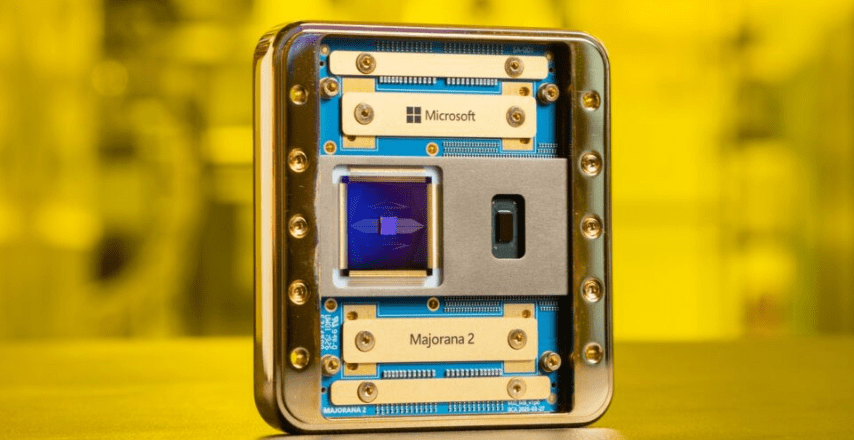
Microsoft may not make very frequent quantum-related announcements, but like Google, Amazon, and IBM, is one of a handful of very large corporate forces influencing the direction of the quantum counting sector.
The company is back in the news this week with its announcement of the Majorana 2 quantum processor, a follow-up to the Majorana 1 chip that was unveiled back in February 2025.
Microsoft’s blog post announcing Majorana 2 states that its new features “include a new materials stack enabling a 1,000-fold improvement in reliability over the prior generation of qubits, with a mean qubit lifetime of 20 seconds and instances lasting as long as one minute.” The company further stated, “Microsoft now expects to achieve a scalable quantum computer by 2029, cutting its original timeline in half.”
What does that mean for the quantum computing market in general? Microsoft has not announced any plans to make quantum processors in bulk or sell them to anyone else. Its roadmap is in line with IBM’s roadmap for producing a fault-tolerant quantum computer, but Microsoft’s planned computer probably will have the most relevance for Microsoft internally. It potentially could be made available through Microsoft Azure, though I’m not sure how the other companies that already have their QPUs available through Microsoft’s cloud service would feel about that.
Microsoft’s ambition to build a topological quantum computer leveraging Majorana particles is a different approach than many are using, and if it succeeds it adds another modality option to a list that already includes superconducting, trapped-ion, neutral-atom, and photonic quantum computing, but who else besides Microsoft has the resources and time to start down the same path?
There are a couple other things worth noting. Majorana 1 generated quite a bit of controversy from critics who questioned the viability of Microsoft’s methods. Majorana 2 involves some significant changes, such as the use of lead instead of aluminum in its materials stack to improve stability against errors, but Science News already is reporting that the critics of the origins version may remain unmoved.
Another thing: Microsoft also announced today the general availability of Microsoft Discovery Agentic AI platform for “Frontier R&D,” and noted that Discovery is playing a key role in informing and accelerating the company’s quantum computing efforts. While quantum computing can have benefits for AI, such as making AI processing more power-efficient, this is a clear example how AI increasingly is playing an important role in the design of quantum processors and computers.
Image source: Microsoft
Quantum News Nexus is a site from freelance writer and editor Dan O’Shea that covers quantum computing, quantum sensing, quantum networking, quantum-safe security, and more. You can find him on X @QuantumNewsGuy and doshea14@gmail.com.




 Quantum News Nexus
Leave a comment