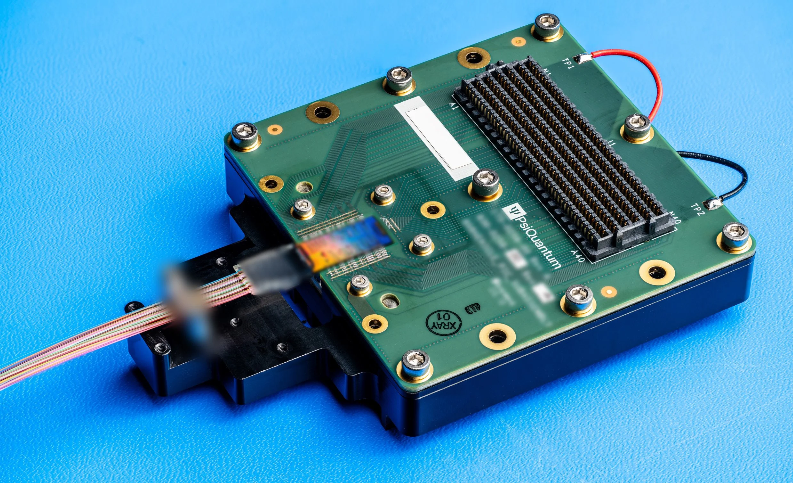
PsiQuantum, a developer of photonics-based quantum computers, is broadening its horizons in a way that makes a lot of sense with a new Optical Circuit Switching (OCS) technology for AI infrastructure scaling and connectivity applications.
The Palo Alto, California, company’s first OCS is an 8×8-radix demonstration vehicle built on the low-loss, silicon photonics platform that PsiQuantum already has been developing for its planned quantum computers. The company stated in a press release, “Testing conducted in PsiQuantum’s labs has shown typical results of 1.2 dB of insertion loss, 40 dB cross talk, and less than 3 ms of reconfiguration time, all exceeding initial targets set for these devices and without amplification.”
For now, PsiQuantum is sharing samples of its demonstration vehicle with select prospective customers, and it plans to announce commercial products based on the OCS technology in the coming months. This move opens up a new opportunity, but also brings PsiQuantum into competition with companies like Lumentum, Applied Optoelectronics, and potentially Cisco Systems and others. The companies providing silicon photonics and co-packaged optics have become stock market darlings this year, much like the memory companies, based on the expectation these technologies will be hugely important to AI scaling in the future.
PsiQuantum has not announced IPO plans or anything of the like, but there has been a lot of speculation in the quantum sector that the company could be heading in that direction. The firm appointed former AMD/Xilinx exec Victor Peng as CEO earlier this year (initially on an interim basis, but it became permanent over the summers), and later was named as one of the handful of quantum companies getting $100 million in funding from the federal government. PsiQuantum also advanced to the third stage of the DARPA Quantum Benchmarking Initiative, and just this month lined up a $150 million loan agreement from the US Department of War.
The OCS announcement may be perceived by some as PsiQuantum diverting itself from its quantum ambitions in favor of a more immediately lucrative opportunity in AI, but that is not the case. As the release stated, “AI and quantum computing are complementary technologies: more efficient AI infrastructure can accelerate the development and operation of quantum systems, while some advances made for quantum computing can help remove bottlenecks in AI infrastructure. As optics make AI infrastructure more efficient, stronger AI infrastructure can in turn support the design, control, and operation of increasingly capable quantum systems.”
Peng added, “This opportunity exists because we chose to solve the hardest scaling problems at the beginning of our roadmap to utility-scale quantum computing. As AI computing pushes infrastructure to its limits, we now have an opportunity to put our state-of-the-art technology to work today while continuing toward our ultimate goal: building and deploying the world’s first useful, fault-tolerant quantum computers.”
PsiQuantum has also developed barium titanate (BTO) integration at the 300mm wafer scale and uses a 64×64 BTO switch in its quantum systems. BTO is not required for the demonstration version of the OCS announced this week.
Quantum News Nexus is a site from freelance writer and editor Dan O’Shea that covers quantum computing, quantum sensing, quantum networking, quantum-safe security, and more. You can find him on X @QuantumNewsGuy and doshea14@gmail.com.



Leave a Reply