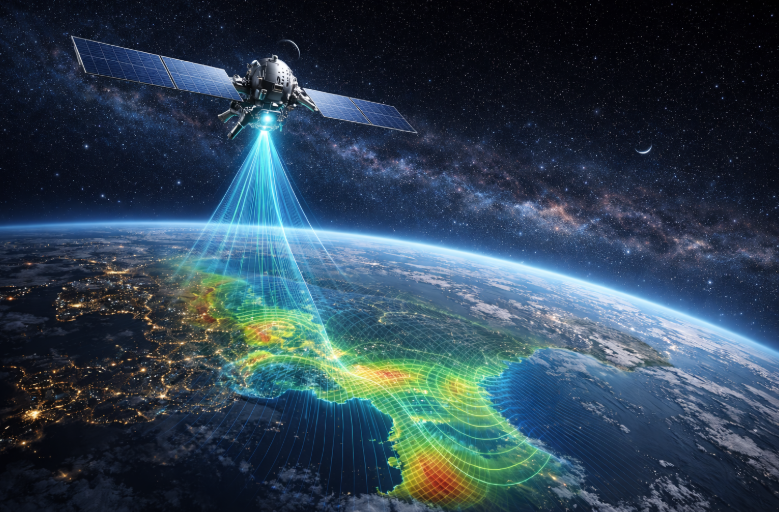
Infleqtion’s relationship with NASA continues to pay off for the quantum firm, as NASA has awarded Infleqtion a $20 million follow-on contract to continue development on the space agency’s Quantum Gravity Gradiometer Pathfinder (QGGPf) mission.
That mission, led by NASA’s Jet Propulsion Laboratory, is aiming to fly the first-ever space-based quantum gravity sensor. Infleqtion was named as a collaborator on the project in early 2026, though its involvement goes back to at least early 2025. Infleqtion’s press release this week noted that NASA’s investment in the QGGPf mission has reached $40 million, and is now advancing into its next phase of hardware development and testing.
“This follow-on award reflects the progress our team has made and marks an important step toward the mission’s next phase,” said Matt Kinsella, Chief Executive Officer of Infleqtion. “The path from quantum science to a system that can fly in space takes years of engineering, testing, and collaboration. Every milestone brings quantum sensing closer to enabling entirely new ways to observe our planet from orbit.”
“There is an enormous amount of potential for quantum technology use cases in space. We are no longer testing the quantum technology itself, but ways we can use it in the space environment,” said Dana Anderson, Chief Science Officer at Infleqtion. “As a NASA-led mission with key contributions from U.S. industry, QGGPf is demonstrating how quantum gravity sensing can operate in low Earth orbit and establishing the technical foundation for future generations of space-based instruments.”
This year has been a busy one for space-based quantum endeavors. In addition to Infleqtion’s work with NASA, companies like IonQ, Boeing, and more have been making space-related moves. Just this week, IonQ announced that dozens of new Skyloom optical communications terminals had been launched into orbit (IonQ acquired Skyloom late last year). Boeing is working on a space-based quantum networking system.
For Infleqtion’s part, it is working with NASA to complete the QGGPf instrument hardware development, after which there will be a flight demonstration. The work under this phase of the program is expected to be performed through 2027, and the mission is expected to launch aboard a low-Earth orbit spacecraft in 2030.
QGGPf builds on NASA’s long legacy of space-based gravity mapping, such as the GRACE and GRACE-FO missions, and applies Infleqtion’s quantum engineering capabilities to enable a new class of measurement techniques designed specifically for the microgravity environment of space.
Image: Infleqtion quantum gravity sensor (Source: Infleqtion)
Quantum News Nexus is a site from freelance writer and editor Dan O’Shea that covers quantum computing, quantum sensing, quantum networking, quantum-safe security, and more. You can find him on X @QuantumNewsGuy and doshea14@gmail.com.



 Quantum News Nexus
Leave a comment