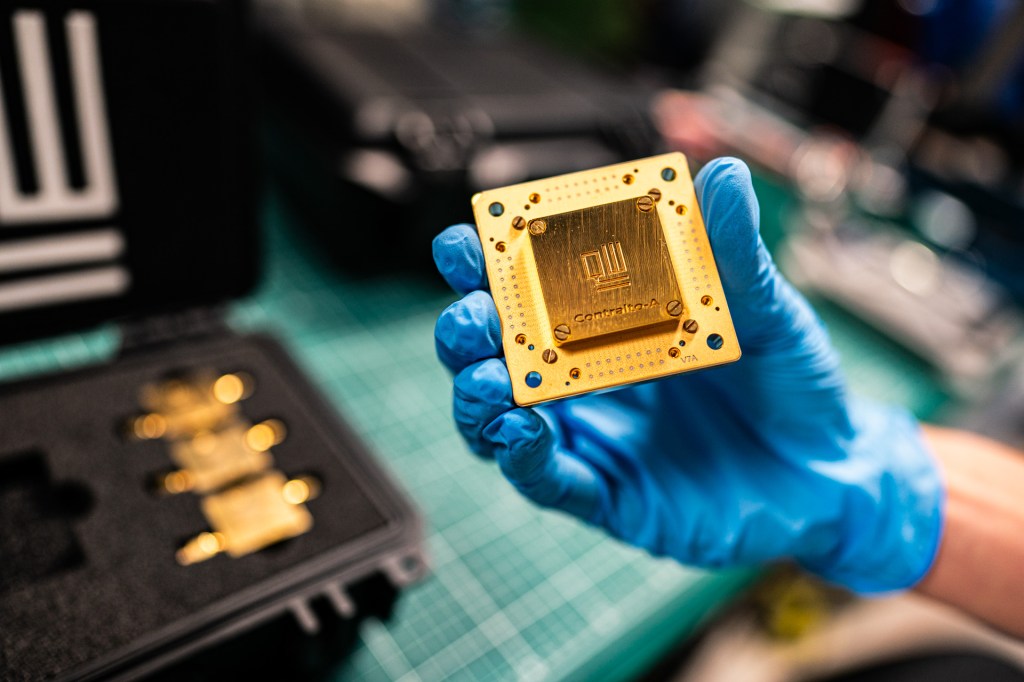
QuantWare, one of several companies that was spun out of the Delft University of Technology (TU Delft) and QuTech research institute in the Netherlands in recent years, announced a $178 million (€152 million) Series B funding round, new which itself came on the heels of the company unveiling a new quantum processor architecture for 10,000 qubits.
New investors joining the round include Intel Capital, In-Q-Tel (IQT), and ETF Partners, with existing investors participating including FORWARD.one and Invest-NL Deep Tech Fund, InnovationQuarter Capital, Ground State Ventures, and Graduate Ventures. The round was heavily oversubscribed, and QuantWare claimed in a press release that it was the largest private financing round raised by a dedicated quantum processor company to date.
While Intel Capital’s involvement is new, it is not exactly surprising. Intel has not been super vocal about its own quantum computing efforts, but it had the foresight way back in 2015 to forge a $50-million investment and collaboration deal with QuTech and TU Delft, so it has been involved in one of the world’s hottest quantum hotspots (starting point for Delft Circuits, Qblox, and QphoX, among others) for quite some time. I generally don’t give Intel as much credit as Nvidia for being deeply involved in the quantum ecosystem, but maybe I should revisit that position?
Among its other quantum funding moves, Intel Capital also has invested in Quantum Machines and was revealed just last month to be an investor in Q-Factor. Both of those firms are based in Israel. Meanwhile, this is just the latest in a string of quantum investments by IQT, the venture capital firm started by the CIA back in the 1990s. IQT over the years has invested in SandboxAQ, Quantum Circuits, Inc. (since acquired by D-Wave Quantum), Q-CTRL, and Quantum Brilliance.
The new funding will provide a big boost to QuantWare’s VIO-40K 3D vertical chip architecture for superconducting quantum computing that will be capable of 10,000 qubits by 2028, 100x larger than the state-of-the-art today, QuantWare said. The money will also benefit the company’s KiloFab, which QuantWare claimed is the world’s largest dedicated quantum open architecture fab, increasing the company’s production capacity by 20x. That facility is set to open later this year.
QuantWare is notable for providing an open platform that can scale the qubit chiplets and designs of third parties via its VIO architecture. The company provides QuantWare-designed QPUs, foundry services, and chiplet packaging, and has more than 50 customers across 20 countries to date.
“In superconducting quantum computing, scale is increasingly constrained by routing, packaging, and manufacturability—not just qubit design,” said Kike Miralles, Intel Capital. “QuantWare recognized that early and built VIO to address it. That combination of technical ambition and execution positions them to become the company on which the future of superconducting quantum systems will be built.”
“The promise of quantum computing, capable of solving humanity’s intractable challenges, can only happen once it can be manufactured and deployed at scale. That is exactly what we are building,” said Matt Rijlaarsdam, CEO and co-founder of QuantWare. “VIO-40K will deliver 10,000-qubit processors on an open architecture that the entire ecosystem can build on, and KiloFab gives us the industrial production capacity to meet rapidly growing global demand. This fundraise accelerates QuantWare, and in doing so, advances the entire ecosystem toward hyperscale quantum compute.”
Image: QuantWare processor (Source: QuantWare)
Quantum News Nexus is a site from freelance writer and editor Dan O’Shea that covers quantum computing, quantum sensing, quantum networking, quantum-safe security, and more. You can find him on X @QuantumNewsGuy and doshea14@gmail.com.



 Quantum News Nexus
Leave a comment