Within the next two weeks, Infleqtion is due to complete a merger with Churchill Capital Corp X (NASDAQ: CCCX, for now) allowing Infleqtion to become a publicly-traded company.
Specifically, Churchill stated in a press release its intent to transfer its shares and public warrants to the NYSE (Infleqtion will trade as INFQ on the NYSE), one of the last remaining steps. The release further stated, “Churchill X expects that the listing and trading of its Class A Ordinary Shares, CCX Warrants and Units will end at market close on February 13, 2026 and that trading of the Common Stock and Warrants will begin on the NYSE at the market open on February 17, 2026.”
That’s, like, soon. Really soon. What kind of world will this baby be born into? Quantum stocks have been ricocheting all over creation since last fall, as funding announcements, M&A, news of progress toward commercial viability, and some cheerleading by Nvidia drove everything up before the reality set in that the game has barely started for much of the quantum computing sector. Infleqtion is one of several quantum companies due for stock market debuts in the months ahead, most of them via SPAC merger, so many, many eyes will be on INFQ’s initial days of trading, and looking out for any news about its pre-merger investor redemption rate, which ultimately will affect its final proceeds from the deal.
Anyway, before all that happens Infleqtion is getting a lot of other news out of its system.
First up, Infleqtion and Quantum Corridor just announced the completion of a quantum timing demonstration over a fiber network that showed up to 40x improvement vs. GPS for keeping digital systems synchronized. The network used for the live test was Quantum Corridor’s 21.8 km. fiber route between Chicago’s ORD10 Data Center (350 Cermak) and the Digital Crossroad Data Center (100 Digital Crossroad Drive) in Hammond, Indiana. That network route was purpose-built for quantum communications, and Quantum Corridor is not letting it sit idle.
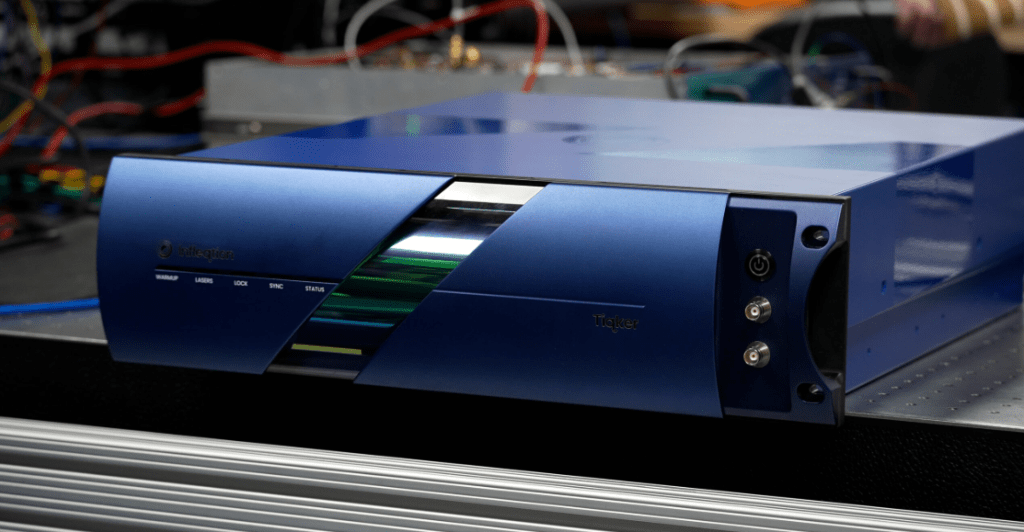
This demonstration came about two months after Quantum Corridor and Toshiba demonstrated quantum key distribution over the same network. In this case, Infleqtion’s rack-mounted Tiqker quantum optical atomic clock was used on Quantum Corridor’s in situ dark fiber to maintain “picosecond-level synchronization while continuing to perform through everyday network activity, including switching events and environmental variation,” the companies said.
Quantum positioning, navigation, and timing (Q-PNT) is set for a really big year after many years of development, and when Infleqtion does start trading, the Q-PNT side of its story will be the one to watch as Infleqtion, like quite a few quantum companies, is getting much more revenue from Q-PNT activities right now than from quantum computing.
But, speaking of quantum computing, Infleqtion also announced in recent days that its quantum software team, along with collaborators the University of Chicago (UChicago) and Massachusetts Institute of Technology (MIT), was selected to advance to Phase 3 of the Wellcome Leap Quantum for Bio (Q4Bio) Challenge, a global program focused on demonstrating quantum-enabled solutions for human health.
Quantum computing has been viewed as a key tool for aiding in the discovery of biomarkers, which are molecules, proteins, and other types of biological indicators whose complexity makes it difficult for traditional computing tools to analyze them.
“Phase 3 allows us to test quantum-enabled biomarker discovery end to end,” said Pranav Gokhale, CTO, Infleqtion. “We’re applying our hybrid quantum–classical workflow to real oncology data and evaluating whether quantum methods can improve feature selection on today’s hardware, not in simulations.”
But there was even more news from Infleqtion this week: The company also announced that it had worked with the University of Wisconsin–Madison on a more reliable method for measuring individual qubits without interrupting ongoing circuits, an issue that has long presented a challenge for improving error correction as other measurement means were capable of introducing errors and causing information to be lost. “The work addresses one of the central challenges in quantum computing by enabling faster computation cycles while preserving fragile quantum states,” the companies stated.
Gokhale added, “This work addresses a fundamental bottleneck in quantum computing. If you can measure qubits accurately without losing them, you can move faster, repeat measurements more reliably, and build systems that scale beyond the laboratory. That is why this result matters.”
Finally, all this news followed by a few days the announcement that Dave Kresse, formerly of Amazon Web Services and Nutanix, had been appointed to the role of vice president of commercial solutions at Infleqtion.
Image: Infleqtion’s Tiqker optical atomic clock. (Source: Infleqtion)
Quantum News Nexus is a site from freelance writer and editor Dan O’Shea that covers quantum computing, quantum sensing, quantum networking, quantum-safe security, and more. You can find him on X @QuantumNewsGuy and doshea14@gmail.com.




 Quantum News Nexus
Leave a reply to Defining gravity: Infleqtion updates on its role in NASA’s quantum gravity sensor mission – Quantum News Nexus Cancel reply