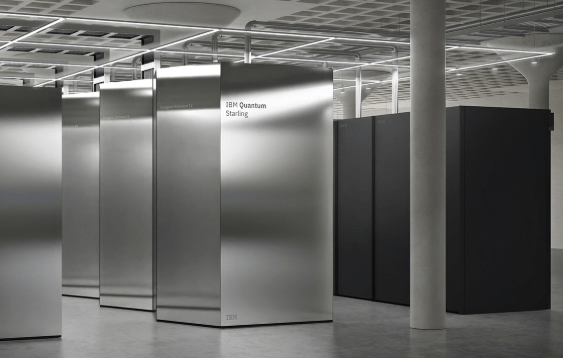
IBM and Cisco Systems just announced they are teaming up to lay the groundwork for “networked distributed quantum computing,” with the aim for their vision to become reality potentially by the early 2030s.
That timing would put the realization of this project right on the heels of IBM’s previously stated target of 2029 for availability of its Starling fault-tolerant quantum computer. This is a really interesting pairing of a couple of huge players. While IBM has been advancing quantum computing milestone by milestone over the last decade, Cisco’s work in the space prior to this year seemed mostly focused around quantum-safe security for communications networks, something that was right in the wheelhouse of the networking and security giant’s interests and expertise.
However, in May of this year, Cisco announced the opening of the Cisco Quantum Lab in Santa Monica, California, and the development of its own quantum chip for entanglement. More recently, Cisco announced in September that it had developed a trio of software applications to run on a “unified quantum networking software stack,” a step toward enabling quantum computers to be networked together to scale their computing power.
That move cemented Cisco’s emergence as an invested player in the quantum technology community, and this partnership shows that Cisco plans to keep its leadership credentials as its core computer and data center networking businesses evolve to add a quantum dimension. The bigger, broader goal here is the development of a quantum internet.
But, we’re getting ahead of ourselves.
An IBM press release outlined how this partnership will proceed: “Within five years, IBM and Cisco will aim to demonstrate the first proof-of-concept for a network that combines individual, large-scale, fault-tolerant quantum computers, enabling them to work together to run computations over tens to hundreds of thousands of qubits. This network would allow problems to be run with potentially trillions of quantum gates, the fundamental entangling operations required for transformative quantum applications such as massive optimization problems, or the design of complex materials and medicines.”
The release added that this demonstration more specifically would seek “to entangle qubits from multiple separate quantum computers located in distinct cryogenic environments. Doing so will require the companies to invent new connections, including microwave-optical transducers and a supporting software stack.”
Ultimately, Cisco has a vision for a quantum data center infrastructure, and IBM and Cisco together believe that developing “a distributed and scalable quantum computing network will create a pathway towards an exponentially large computational space and enable the expansion of diverse technologies, which could begin to form a future quantum computing internet by the late 2030s.”
The tone of this announcement is optimistic, but it is clear IBM and Cisco do not want to sound too visionary or promise too much. Despite their caution, I have a prediction: People who used to complain about fault-tolerant quantum computers being 15 years away (and now must accept they are less than five years away) are going to start complaining about having to wait another 15 years for the quantum internet.
The eventual development of a quantum internet infrastructure depends on a re-thinking of the traditional network components like routers and transducers. With that in mind, IBM plans to build a quantum networking unit (QNU) that, according to the announcement, would “serve as the interface to a quantum processing unit (QPU), with the explicit task of taking stationary quantum information in the QPU and converting it into ‘flying’ quantum information through the QNU to then be further linked across potentially multiple quantum computers through a network.”
Flying quantum information? Can’t wait.
The release added, “Cisco’s quantum network would aim to distribute the entanglements to arbitrary pairs of these QNUs on an on-demand basis to drive the quantum information transfer required for a given quantum algorithm or application. Towards this goal, Cisco is developing a high-speed software protocol framework that can continuously and dynamically reconfigure network paths so entanglements could be distributed to the QNUs when they are done with their partial computations.”
The partners also will look at how a “network bridge, comprised of novel hardware and open-source software, could use Cisco quantum network nodes to link many IBM QPUs within a data center through its QNU interface.” The next step beyond that would be supporting the linking of QPUs across multiple data centers and increasingly longer distances until–Presto!–quantum internet.
Kidding. There’s a long way to go, but this is a really significant pairing that will help the industry toward its quantum internet goals.
Quantum News Nexus is a new site from freelance writer and editor Dan O’Shea that covers quantum computing, quantum sensing, quantum networking, quantum-safe security, and more. You can find him on X @QuantumNewsGuy and doshea14@gmail.com.





Leave a Reply