With its latest AI chips, AMD has started chipping away at Nvidia’s dominance in that market. Is it now positioning to do the same in the quantum computing sector as quantum and AI converge?
Though AMD has never been tremendously vocal about its quantum endeavors, it has worked with quantum luminaries like Riverlane, and has supported a fair bit of research on leveraging quantum and AI in supercomputing. Late last month, AMD aligned with quantum computing pioneer IBM in its most highly publicized quantum move thus far.
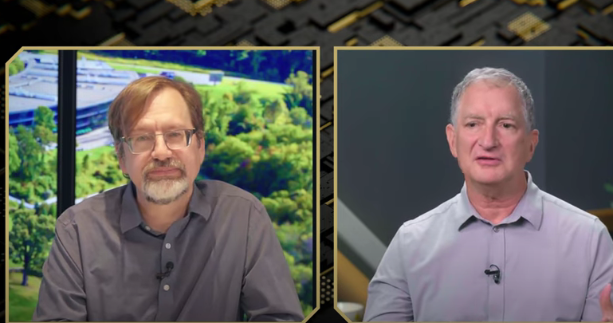
Most recently, AMD offered up a new episode of its Advanced Insights Series, in which AMD CTO Mark Papermaster (on the right in the above photo) hosts Scott Crowder, IBM’s VP of Quantum Adoption (on the left), to talk about some quantum computing basics, how hybrid classical-quantum systems are evolving, and the importance of CPUs, GPUs, and QPUs working together.
As Crowder puts it at one point, quantum-centric supercomputing “enables you to basically solve problems you can’t solve with just GPUs and CPUs, but you also can’t solve them without CPUs and GPUs. It’s the combination that allows you to solve it.”
Anyway, I found this conversation way less dry and stilted than I expected to be, perhaps owing to Papermaster and Crowder having been co-workers at IBM back in the day. Both also are good at breaking down the relationship between classical and quantum computing, and overall it’s another positive step by AMD to position itself in quantum.
What’s next for AMD in this sector? I would hope more partnerships, but it is also worth noting that AMD has averaged a couple acquisitions a year in recent years. Deals it has done in recent years have helped AMD strengthen its case in AI inference and software, and FPGAs, among other areas. M&A has not been a big story in quantum lately, with IonQ alone being responsible for most of the recent activity, but AMD makes for an interesting potential buyer.


 Quantum News Nexus
Leave a reply to A quantum watcher’s guide to earnings season – Quantum News Nexus Cancel reply