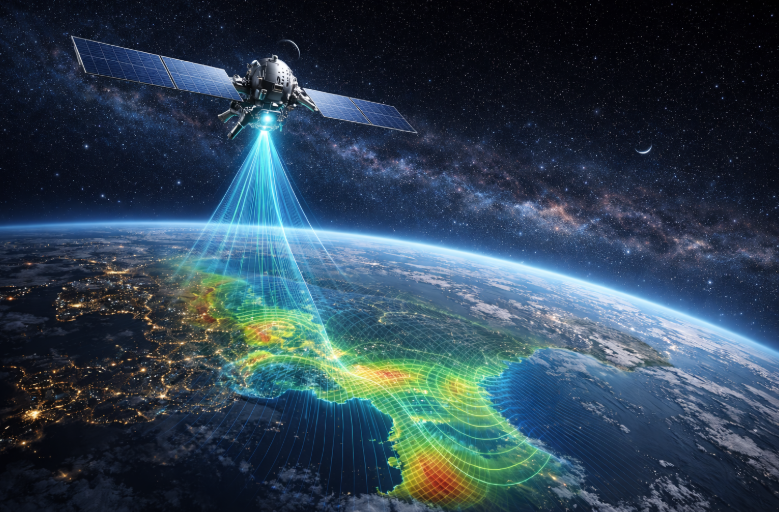
While Americans have been captivated recently by the Artemis II moon fly-by, it should not go unnoticed that we also are starting to send quantum technology into space.
This effort has been advancing for several years, as NASA, the European Space Agency, satellite communications ventures, and other space agencies and private sector firms started exploring quantum in earnest a decade ago. In 2018, in what is believed to be the first launch of quantum hardware into space, a Colorado company called ColdQuanta (now known as Infleqtion) worked with NASA to send quantum vacuum chamber technology to the International Space Station (ISS) to be used in the ISS Cold Atom Laboratory (CAL). Infleqtion’s collaboration with NASA continues, and the company just this week announced it is providing upgraded quantum hardware to the ISS through NASA’s Northrop Grumman-24 (NG-24) cargo mission, which currently is scheduled to launch Saturday morning.
“The upgraded physics package for the Cold Atom Laboratory (CAL), developed in collaboration with NASA’s Jet Propulsion Laboratory (JPL), may enable record-breaking in-orbit atom populations, record ultracold temperatures, and facilitate creation and study of simultaneous dual-species quantum gases,” Infleqtion’s press release stated. “These advances could unlock new experimental capabilities with the potential to improve navigation, strengthen Earth monitoring, and support critical infrastructure resilience.”
Infleqtion’s work with NASA will continue beyond this week as well, as the company in February announced its role as a top collaborator in NASA’s Quantum Gravity Gradiometer (QGG) Pathfinder mission to send a quantum sensor into low Earth orbit to measure the planet’s gravitational field. That mission will blast off around 2030 or so.
Noah Fitch, vice president of emerging technologies at Infleqtion, recently spoke with QNN about Infleqtion’s history with NASA, the CAL project, the QGG Pathfinder mission, and why quantum sensing in space is an idea that makes… sense.
(This conversation occurred before this week’s news announcement.)
QNN: Infleqtion has been working with NASA for almost 15 years, before the company was even called Infleqtion. How did this collaboration start?
Noah Fitch: Infleqtion has been working with NASA and JPL since about 2012 for the Cold Atom Laboratory mission on the International Space Station. We provided hardware for the heart of that system–the quantum vacuum chamber–and all the things to control the ultra cold atoms that they produce on the space station. That goes back to when Infleqtion was called ColdQuanta, and we were a company of about 12 people, and were approached then by JPL to put commercial quantum hardware in space. We’ve had multiple rounds of upgrades and deliveries to that program. In fact, we just finished up some deliveries in December, and next month [This conversation occurred in March], an upgraded package is getting rocketed up to the space station, so I’ll get to be in Florida in a few weeks and watch the launch. In many ways, many of the techniques that are the basis of the QGG mission we’re working on now were first kind of path-findered in the CAL project.
QNN: And, how did you go from supplying tech for the CAL to now playing a big role in the QGG Pathfinder mission?
Fitch: The CAL is a scientific instrument. It’s accessed by scientific PIs [principal investigators] as a remote service of ultra-cold atoms in microgravity, and they’ve done a lot of good science, The ultra-cold temperature that you can only achieve in microgravity is a fantastic and crucial ingredient for the QGG, as well as some of the atom interferometry ideas and experiments that happen [in the CAL] all kind of laid the path for for what we think we can do with with QGG. The QGG project itself was instigated a few years ago by NASA. They did a study, and they invited many industry partners and quantum partners to submit studies on what they think such an instrument might look like, the formulation phase to figure out what the art of the possible would look like and how much it might cost. It progressed through another phase, and last summer we were selected to be the prime industry provider for the payload. This is a much bigger system-level job for Infleqtion than CAL was. That was for one sub-component of a more complicated system that the JPL managed. In QGG Pathfinder, we’re biting off a lot more scope, and a lot more of our hardware will be flying around the planet.
QNN: You touched on microgravity conditions being “crucial” to the QGG project? How will sending a QGG into space affect what you can do with it?
Fitch: You can think of quantum sensing as a frontier in its own right, and then getting that tech to space has an extra level of difficulty that is both highly intriguing but also highly meaningful. Space is a place that we’re exploring more rapidly and more aggressively than ever before. There are plans to go to the moon [as part of NASA’s current Artemis program]. There are plans to send more things to Mars. There are more satellites going up every day. Space also represents an environment that’s uniquely suited for a lot of quantum sensing architectures, and allows them to perform better.
Many of our quantum sensing architectures actually have higher performance thresholds or higher performance ceilings in environments like microgravity. The longer you can have your measurement last, the more sensitive your measurement can be. That really comes down to sensing based on atom interferometry [which relies on the properties of cold atoms for precise measurements]. The benefits of being in microgravity are twofold. One, in that kind of environment your atoms don’t fall away from you as you’re making the measurement. And two, you can achieve much, much colder temperatures in your atom clouds. In atom interferometry, we use very, very cold, cold clouds of atoms cooled within a few billions or even trillions of a degree of absolute zero. In microgravity, you make your samples much, much colder, and can make measurements for longer amounts of time. This improves sensitivity, it improves stability, and it improves deployability because your systems don’t have to be so big to be sensitive.
QNN: Will that sensitivity enable better gravity measurements than have been possible before from space with other sensors?
Fitch: NASA has an extremely rich history, more than 25 years now, of measuring the Earth’s geoid through the GRACE-C [Gravity Recovery and Climate Experiment-Continuity] missions using classical sensors to provide information about the mass distribution of the planet and how that’s evolving over time. [Because NASA gravity data is frequently quoted and relied upon by governments, scientists, water authorities, and others] NASA wants to make those measurements even better. Right now, NASA is limited by both the resolution and the sensitivity of those classical sensor measurements. The resolution of what they can see happening on the planet is about 200 kilometers or so. You can see [through changes in soil mass as water is absorbed] if it’s raining in the Central Valley of California, but you can’t tell if it’s raining in a particular county, for instance. And when I would say raining. They want to make both higher resolution to get down to the 100 kilometer level resolution, and also higher sensitivity in terms of what changes they can detect. So they have been working on this for many, many years.
QNN: QGG is one kind of quantum sensing device, but do you also see quantum sensing’s precision in general being beneficial for other space applications?
Fitch: Space is an environment where you don’t have access to a lot of the tools that you take for granted while you’re on the planet Earth, as it were, like GPS for navigation, or being able to calibrate your sensors by sending them to NIST. You don’t have access to those things off-world to ensure you’re getting good measurement. It’s also an environment where mistakes are extremely costly, such as doing autonomous operations off-world that may or may not be controlled by a human with a remote control. Communication delays over these kind of distances makes things like that kind of impossible, so you need the best possible data about your environment to work there, and that’s where quantum kind of plays best. We’re talking about the ability to build the world’s–or off-world’s–most sensitive and most stable sensing devices. When it really matters, that’s that’s where quantum will outperform the best [classical] clocks or inertial sensors or gravity sensors. The best versions of those that we’ve ever built on the ground are all quantum-based. And, the challenge, of course, is to get them to space and to have that same kind of performance. But that’s that’s the promise of quantum in space.
QNN: Since you mentioned the challenge, do you mean how to deal with radiation, heat, power consumption and form factor limits, and your limited ability to tweak the system on the fly, pun intended?
Fitch: I often joke that it’d be awfully nice to send up a graduate student with our system to tweak the knobs once it was up there. Certainly, it’s a very big engineering challenge to get such a precision device not only working in the first place, but also up into orbit and maintain that performance once it’s there. There are three main challenges of the space environment. For one, vibrations during launch are a big deal, and how we manage that. We’re working very closely with people who are experts in this, not only people that we brought on to our own team, but also with, of course, NASA JPL and Goddard [Space Flight Center] on that front. Radiation is another challenge. This is a Pathfinder mission, so it’s not a science mission where you need it to last for 30 years, so our radiation tolerance is a little bit higher than it otherwise would need to be. We want to make sure that the system will work and not get damaged through a year or so of operations. And then the third one is thermal. We’re going to be flying around the planet, and one side of the satellite sees the sun, and the other side sees deep space. And so you end up with large thermal gradients across the satellite. Things like size, weight and power are pretty well under control for all of our deployed quantum systems. It’s these environmental conditions that are therefore different. We’re doing everything from Shaker tables [which test equipments response to heavy vibrations] to radiation testing to thermal vacuum testing, and putting in all the effort that’s needed to make sure this thing works after it’s gone through launch and deployment and the unfolding of solar sails and all the all the steps necessary to get it up there.
QNN: We’re still a few years away from the launch of the QGG, but could we soon start to see more urgency develop around space-based quantum sensing?
Fitch: For now, space is a great opportunity for us to do low-volume, very difficult engineering and physics solutions to problems that otherwise may not have a solution. [Space missions develop slowly] but with the commercial space stations meant to come online in the next decade, getting things into space is becoming easier than ever before. I think that will increase the cadence for getting quantum sensors up there to do useful solutions, and I only see activity going up from here. There are many other international efforts to do atom interferometry and quantum sensing in space. That includes China on their own space station and some free-flying satellite work. QGG is what I consider the flagship US effort to get quantum sensing in space, and then Europe has the CARIOQA mission, which is meant to fly a quantum gravimeter, so not a gradiometer, around the same time frame. So, we’re kind of in a race to get there and show utility and real quantum advantage so that we can open more doors for the technology.
Image: Illustration of quantum gravity sensing from space. (Source: Infleqtion)
Quantum News Nexus is a site from freelance writer and editor Dan O’Shea that covers quantum computing, quantum sensing, quantum networking, quantum-safe security, and more. You can find him on X @QuantumNewsGuy and doshea14@gmail.com.


 Quantum News Nexus
Leave a comment