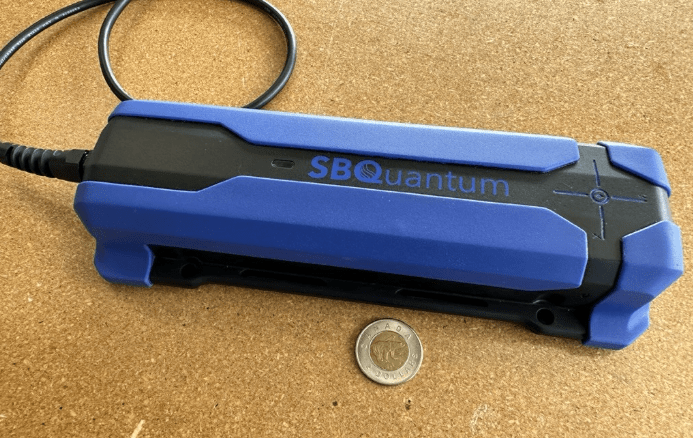
And just like that, we have achieved liftoff for a quantum diamond magnetometer. SBQuantum announced that its quantum sensor was launched into space aboard a SpaceX Falcon 9 rocket as part of the final phase of the U.S. National Geospatial-Intelligence Agency’s (NGA) MagQuest Challenge.
This is the latest development in a seven-year, multi-million effort, according to the Sherbrooke, Canada, company’s press release. SBQuantum’s involvement in the Magquest project goes back to the beginning in 2019, which gives you an idea how long quantum sensors have been under development for real-world projects. SBQuantum also has been working with other agencies around the world, such as the European Space Agency (ESA), on quantum magnetometers.
It’s heady time for quantum sensors being developed for space missions. Infleqtion also has talked about its role in NASA’s planned Quantum Gravity Gradiometer Pathfinder mission. (In fact, I’ll have a bit more on this later this week following a recent interview with Infleqtion.) Quantum magnetometer and gravity gradiometers are just a couple of examples of the different types of quantum sensors that could be put into orbit applications ranging from Earth observation to space navigation and military and defense use cases. NASA, the ESA, and other parties are actively involved in programs that could result in many quantum sensors being launched into space in the years to come.
As for the NGA, its MagQuest project was created as a competition to identify and accelerate new technologies to monitor Earth’s magnetic field and ensure the accuracy of the World Magnetic Model (WMM), which underpins navigation systems that are used worldwide by airlines, military, and smartphone users. SBQuantum said the satellites currently collecting the data needed to produce the WMM are approaching end of life, while at the same time Earth’s magnetic field is also shifting at an accelerating rate, making continuous, raising the bar for more accurate measurement and monitoring solutions.
SBQuantum is answering that call with a device that is roughly the size of a quarter of milk.
“Reaching the final phase of MagQuest is the most significant technical milestone in our company’s history,” said David Roy-Guay, Founder of SBQuantum. “Our technology has now been validated for the most demanding conditions imaginable, and we are proud to bring to market a device which could soon play a central role in how the world navigates on land, air and sea. Applications for this sensor go far beyond the WMM itself, from defense and navigation to resource exploration and public safety. We believe quantum sensing is the next frontier, and we are at the forefront of delivering on its potential.”
SBQuantum is competing as part of a partnership with Spire Global, a provider of space-based data and analytics through satellite infrastructure, ground stations and data processing capabilities that complement SBQuantum’s magnetometer technology, SBQuantum said. The final phase of the Magquest challenge is expected to conclude in the fall of this year, with results informing the NGA’s acquisition strategy for WMM data collection capacity, expected to be operational by 2030, SBQuantum stated.
Quantum News Nexus is a site from freelance writer and editor Dan O’Shea that covers quantum computing, quantum sensing, quantum networking, quantum-safe security, and more. You can find him on X @QuantumNewsGuy and doshea14@gmail.com.


 Quantum News Nexus
Leave a comment