Infleqtion CEO Matt Kinsella is set to take the stage at Quantum World Congress tomorrow for a keynote speech, during which he is probably going to be talking an awful lot about the next-generation architecture and roadmap for the Colorado company’s Sqale quantum computer.
Today, Infleqtion revealed some early details of that architecture, as well as an interesting claim on the security front.
First up, the company said it expects to deliver a full-stack fault-tolerant system with more than 1,000 logical qubits by 2030, putting it right around the same time frame for fault-tolerancy as IBM and a few others. (2029 and 2030 are going to be a wild couple of years for quantum moving to the forefront of computing, assuming, you know, we all survive until then.)
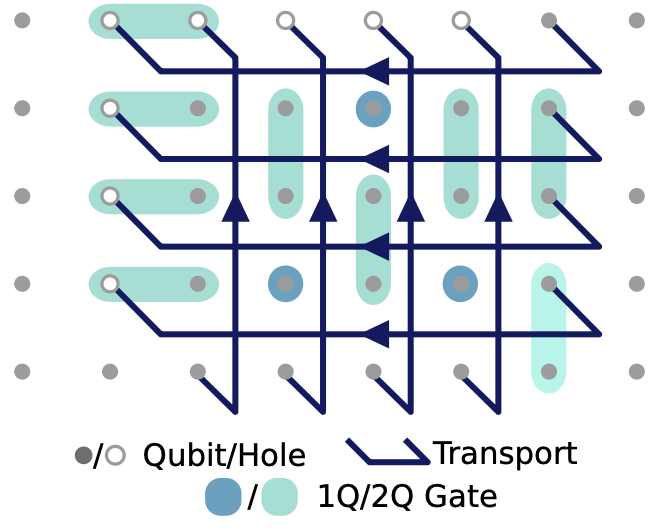
An Infleqtion press release offered further details on the new design for its Sqale neutral atom-based machine, saying it “unites the company’s pioneering individual qubit addressing capabilities with dynamically reconfigurable atom arrays. An architecture with this unique combination maintains all-to-all connectivity, while minimizing the pitfalls associated with atom motion, including wall clock runtime cost, error accumulation, and atom loss.”
All that is helping Infleqtion accelerate past the mile markers on its previous roadmap. The company said it already has achieved 12 logical qubits with error detection and loss correction, positioning it ahead of schedule for its previous target of achieving 10 logical qubits with error correction in 2026. It’s now aiming to reach 30 logical qubits next year ahead of the goal of 1,000 by 2030.
“With our new architecture and updated roadmap, we’re accelerating innovation and execution toward fault-tolerant quantum computing,” Kinsella stated in the release. “Infleqtion is proving that neutral atoms can deliver a scalable, commercially practical path forward and we’re building the systems that we anticipate will make quantum useful for solving real-world problems by the end of this decade.”
As for the security-related claim, Infleqtion said the new architecture also has allowed it to perform the “first-ever” execution using logical qubits of Shor’s Algorithm for factoring, though it qualified that achievement by stating it was applied to “a simplified version” of Shor’s Algorithm. In any case, that is another step in demonstrating how a quantum computer running Shor’s Algorithm could be used to crack current encryption, and Infleqtion said the demonstration “is intended to inform ongoing migrations to quantum-safe encryption.”
Infleqtion CTO Pranav Gokhale added in a statement, “For the first time, we’ve shown that logical qubits can outperform physical qubits on this cryptographic task. While this run of Shor’s algorithm factored only a small number [15], it shows the trajectory we’re on and the responsibility we share to prepare to accelerate the move to quantum-safe encryption.”
The company’s claim seems to go beyond what some other firms have said regarding their own “simulations” of executions of Shor’s algorithm by calling it a “hardware-based demonstration using logical qubits with measurable fidelity improvements over physical-only implementations.”
A more detailed technical overview of this demonstration, as well as examples of several other applications, is available in the following pre-print publication: https://arxiv.org/abs/2509.13247
Image caption: Infleqtion’s new quantum computing architecture – uniting individually-addressed gates (blue and green ovals) with mid-circuit atom rearrangement (dark blue trajectories) – unlocks efficient demonstration of new algorithms. Source: Infleqtion



 Quantum News Nexus
Leave a comment